The Kerbside Levy: Council Parking Rules and the True Annual Cost of an EV in 2026
Photo: Unknown, Public domain, via Wikimedia Commons
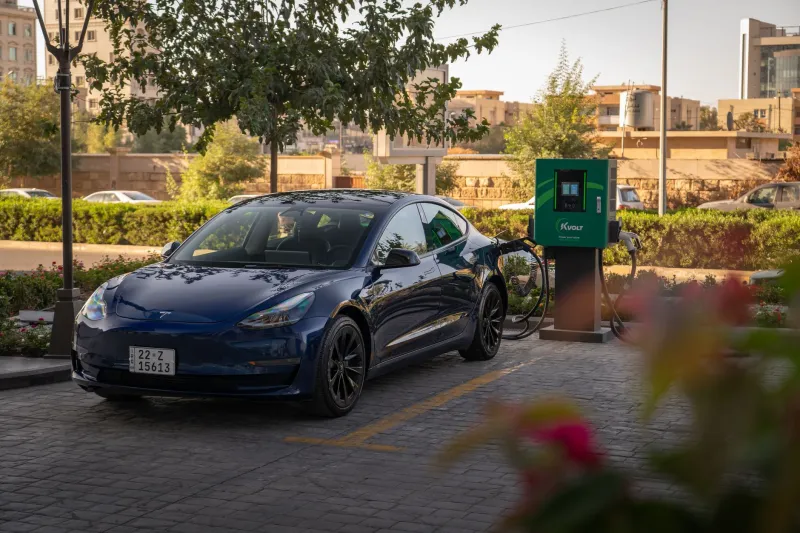
For years, the cost of running an EV in the UK has been framed as a contest between home tariffs and public charging rates. That framing misses a third bill that many drivers pay without noticing: the council parking charge. In 2026, as local authorities review EV parking permits, residents' bays and town-centre concessions, the kerbside is becoming a priced asset. For drivers who rely on public charging near home, parking policy is not a side issue. It is part of the charging tariff.
Why parking belongs in the charging calculation
A public charge point does not exist in isolation. It sits inside a parking bay, on a street or in a car park governed by civil parking rules. If an EV driver must hold a residents' permit to leave the car on the charger overnight, or pay a town-centre tariff while topping up during the day, the cost per kilowatt-hour is incomplete without that parking line.
This matters most where off-street parking is scarce. A driver with a driveway can treat home charging as the default and public charging as an exception. A driver in a flat or terraced house without a driveway may use a kerbside charger, a residents' bay or a nearby car park as routine infrastructure. For that driver, a permit fee is not an occasional penalty. It is a fixed annual cost of keeping the car charged.
The arithmetic is straightforward. A 7 kWh top-up at 55p per kWh costs £3.85 in electricity. If access to that charger also requires a £120 annual permit used mainly for charging, the effective cost of each small session rises sharply over the year. At low mileage, the fixed parking cost can dominate the variable electricity cost.
Three levers councils are using in 2026
Published 2026 parking schedules show three common levers. The first is permit pricing. Several councils have narrowed EV discounts, moved residents' permits onto emissions-based scales or introduced administration fees for applications and replacements. The pattern is not uniform: some authorities still offer a nominal charge for low-emission vehicles, while others have moved EVs closer to standard residential rates. In London, published scales can be materially higher than outside the capital, but the direction of travel is visible in many town-centre schemes.
The second lever is time. Charging bays are increasingly subject to maximum stays, no-return periods and parking charges after an initial free period. A two-hour limit may suit a shopping trip but not an overnight charge. Drivers who must move the car, or who risk an overstay penalty because a charge session runs long, face a cost that is neither electricity nor parking in the ordinary sense. It is the cost of scheduling around the council's clock.
The third lever is the withdrawal of broader concessions. Free or discounted EV parking at meters, season-ticket discounts and town-centre exemptions have been reviewed in many areas. Where an EV once parked without charge while using a public charger, the same space may now attract a standard tariff or a reduced but still material fee. The concession has not always disappeared; it has been repriced.
The annual arithmetic
A useful way to audit a council scheme is to build a simple annual parking-and-charging budget. The figures below are illustrative, but they reflect the range of published 2026 schedules and the way separate charges combine.
| Cost line | Lower annual case | Higher annual case |
|---|---|---|
| Residents' or kerbside permit | £0 | £180 |
| Paid parking linked to public charging | £40 | £320 |
| Overstay or idle-related penalties | £0 | £120 |
| Lost free or discounted parking | £0 | £260 |
| Illustrative total | £40 | £880 |
Not every driver will meet every line. A motorist with a driveway may pay none of them. A driver in a controlled parking zone who depends on a kerbside charger may meet most. The point is that the total is large enough to change the pence-per-mile calculation.
Take a driver covering 6,000 miles a year at 3.5 miles per kWh. That is roughly 1,714 kWh of electricity. If council parking rules add £250 a year to the cost of accessing public charging, the parking line alone is equivalent to about 14.6p per kWh. Added to a 50p per kWh public tariff, it pushes the effective rate towards 65p per kWh before any overstay fee. For a lower-mileage driver, the same £250 is spread over fewer miles and can look even more punitive.
The near-home penalty
Council parking charges do not fall evenly. They bite hardest where public charging substitutes for a driveway. In streets of terraced housing, flats and converted buildings, a residents' permit may be the only practical way to keep a car near a charger. If the council charges for that permit, or limits the hours in which it can be used, the driver is not simply paying for electricity. They are paying for the right to store the car while it charges.
This is also where time limits interact with charging speed. A slow kerbside charger and a short maximum stay are a poor combination. The driver may need to return before the battery is ready, or pay for parking after the charge has finished. In cost terms, the session becomes a compromise between electricity price, parking price and personal time.
How to audit your own council
A practical review should ask five questions. Is the EV permit discount automatic or does it require a paid application? Does the permit cover the specific charging bay, or is charging parking charged separately? What is the maximum stay, and does it reset after a no-return period? Are overnight hours treated differently from daytime hours? And what is the penalty for overstaying or remaining connected after charging ends?
The answers should then be placed into an annual budget, not judged session by session. A £3 parking charge looks small at the point of use. Repeated weekly, it becomes a three-figure line. A permit fee that appears reasonable in January can look different when set against the electricity used by a low-mileage car.
The bottom line
In 2026, council parking policy is no longer a peripheral matter for EV drivers. It is a cost layer that sits between the charger and the electricity tariff, and it falls most heavily on those without a driveway. The prudent approach is to treat permits, time limits and lost concessions as part of the annual charging bill. At EV Charger Costs, that means calculating the kerbside levy alongside the kilowatt-hour price, because the true cost of charging is increasingly decided as much by the parking notice as by the meter.