When the Pavement Is Your Forecourt: Annual EV Charging Bills Without a Driveway in 2026
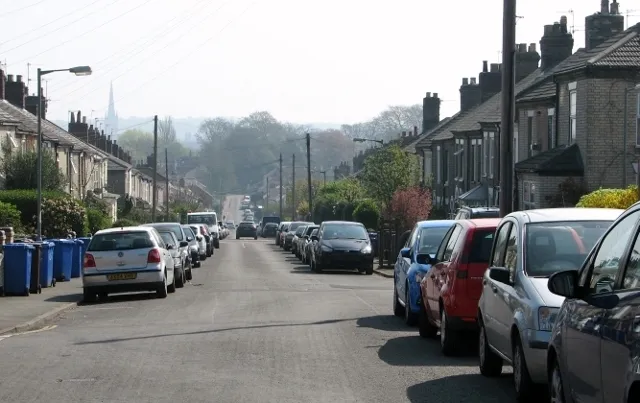
Photo: Evelyn Simak , CC BY-SA 2.0, via Wikimedia Commons
For a driver with a driveway, the cost of running an electric car is mostly a private arithmetic exercise: kilowatt-hours consumed, tariff rate applied, standing charge unchanged. For a driver in a terraced street, a flat or a rented house without off-street parking, the same exercise becomes a public one. The charger may be a lamppost, a council bay, a cable run across the pavement under permit, or a rapid unit at a motorway services. Each option carries a different price per kilowatt-hour and, just as importantly, a different set of access costs, restrictions and practical compromises.
The result is what might fairly be called a terrace tax: the additional annual outlay faced by households that cannot charge on their own land. It is not a single fee or a formal levy. It is the accumulated difference between domestic tariffs and public ones, plus permits, hardware and the value of time. In 2026, with public rapid charging still substantially more expensive than home electricity, that difference remains material.
The baseline: what a driveway owner actually pays
A useful comparison starts with a typical driveway household covering 6,000 miles a year. At an efficiency of 3.5 miles per kWh, the car needs roughly 1,714 kWh over twelve months. On a home tariff of about 25p per kWh, the energy cost is approximately £429. A smart off-peak tariff can lower that figure further if a meaningful share of charging is shifted overnight, although the standing charge applies whether or not the car is plugged in.
That £429 is the benchmark. It is not the full cost of owning an EV, and it excludes the purchase and installation of a wallbox, but it is the right marginal energy figure for comparing charging methods. The question for a household without a driveway is how far above that benchmark it must go.
The kerbside options and their real prices
Lamppost charging has expanded in several UK cities, but it is not a national solution. Where available, it typically costs more than domestic electricity because the operator must recover installation, maintenance and payment costs. A rate of 40p to 55p per kWh is common in 2026, with some councils offering resident tariffs or overnight windows. At 45p per kWh, the annual energy bill for 6,000 miles rises to about £771.
Council-run charge points in residential bays can be cheaper, but availability varies widely. Some schemes charge a subscription or permit fee; others price by session or by kilowatt-hour. A realistic range is 35p to 50p per kWh, before any annual permit. For a flat dweller relying on a public slow charger at 35p per kWh, the annual energy cost is around £600.
Cable-crossing permits are a more niche workaround. A small number of councils allow residents to run a protected cable across the pavement from their own supply, subject to an application, a cable ramp or cover, and public liability requirements. Where permitted, the energy itself is charged at the domestic rate, so the annual energy cost can remain near £429. The additional costs are administrative and practical: application fees, a cable ramp or high-visibility cover, and the risk that the permission is withdrawn or restricted. A household that can use this route may pay £50 to £150 in one-off or annual extras, which still leaves it well below lamppost or rapid charging.
Public rapid charging is the most expensive routine option. Rates of 70p to 85p per kWh are common on the UK network in 2026, with some ultra-rapid sites higher still. At 75p per kWh, 6,000 miles costs about £1,286. A household that splits its charging equally between a lamppost at 45p and a rapid unit at 75p faces a blended rate of 60p per kWh, or roughly £1,029 a year.
Comparing household types
The table below uses the same 6,000-mile annual distance and 3.5 miles per kWh efficiency. It excludes any network subscription, parking charge or permit unless stated.
| Household type | Typical main method | Illustrative rate | Annual energy cost |
|---|---|---|---|
| Driveway, standard tariff | Home wallbox | 25p/kWh | £429 |
| Driveway, off-peak tariff | Home wallbox, timed | 12p to 25p/kWh | £275 to £429 |
| Terrace, lamppost | Kerbside lamppost | 45p/kWh | £771 |
| Terrace, permitted cable crossing | Domestic supply plus permit | 25p/kWh plus extras | £429 plus £50 to £150 |
| Flat, public slow charger | Residential bay or destination | 35p/kWh | £600 |
| Flat or rented, mixed public | 50% lamppost, 50% rapid | 60p/kWh | £1,029 |
| Flat or rented, rapid-reliant | Public rapid | 75p/kWh | £1,286 |
The spread is stark. A rapid-reliant household can pay roughly £850 more per year than a driveway owner on a standard tariff. Even a relatively favourable lamppost arrangement carries a premium of about £340. For a household already paying a premium for rented accommodation or a flat, the charging penalty compounds an existing housing cost.
Which workarounds genuinely reduce the terrace tax
The most effective workaround is still access to a private or semi-private slow charger. A permitted cable crossing, where councils allow it, is financially attractive because it uses domestic electricity. It is not universally available, and it requires responsible cable management, but it is often the cheapest kerbside solution for a terraced house.
Resident lamppost tariffs and council overnight schemes are the next best option. A lamppost at 40p per kWh is still more expensive than home charging, but it is substantially cheaper than rapid charging and avoids the time cost of detouring to a motorway services. Drivers should check whether their council offers a resident rate, an off-peak window or a subscription that lowers the per-kWh price.
Workplace charging can be transformative if it is available. Many employers offer charging at a flat rate or a subsidised rate, and a driver who can cover most weekly mileage at work may reduce public charging to a minor top-up. This is not a universal solution, but it is often overlooked in household cost comparisons.
Community charging hubs and destination chargers can also help, provided the driver is not paying for parking or overstaying. A 7kW charger at a supermarket or leisure centre at 30p to 40p per kWh is cheaper than rapid charging, but only if the journey is already being made. Detouring to find cheap charging rarely pays once time and mileage are counted.
Rapid charging should be treated as a tool for longer journeys and emergencies, not as a default weekly habit. For a household that must rely on it, the annual bill is high, but the premium can be limited by combining rapid sessions with cheaper slow charging where practical and by avoiding idle fees and session charges.
The bottom line for 2026
The terrace tax is real, but it is not fixed. A driveway owner on a standard tariff might spend around £429 a year on energy for 6,000 miles. A lamppost user might spend £770. A rapid-reliant flat dweller might spend £1,286. The difference is driven less by the car than by the charging infrastructure attached to the home.
For drivers considering an EV without a driveway, the sensible approach is to price the specific local options rather than the national average. A nearby lamppost, a council bay, a workplace charger or a permitted cable crossing can each change the annual figure by hundreds of pounds. The car may be the same; the forecourt is not.