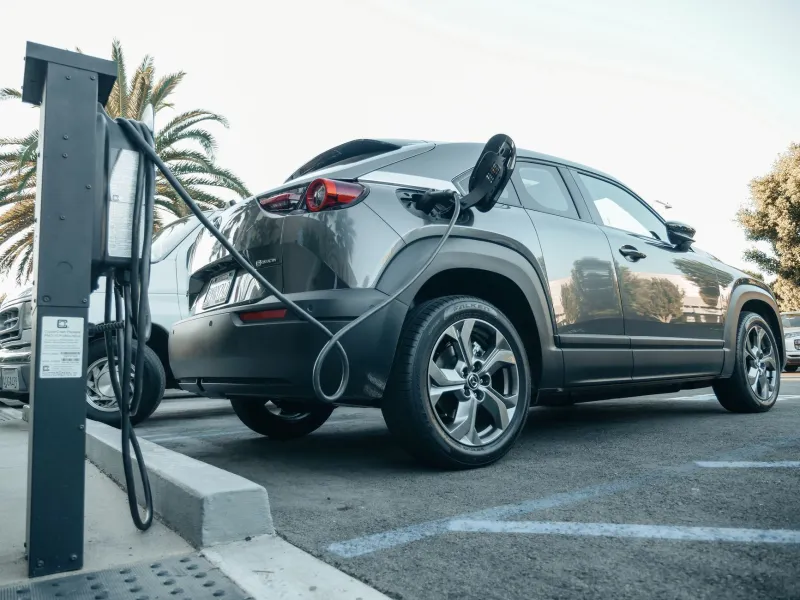
The £400 Spread: Why UK Home EV Charger Quotes Diverge in 2026
Photo: Internet Archive Book Images, No restrictions, via Wikimedia Commons
The quotation arrives as a single figure, but it is really a bundle of decisions. Two drivers in the same town can buy the same 7kW smart charger and receive installed prices separated by £400 or more. The hardware is rarely the source of the gap. The difference sits in survey assumptions, connection fees, cable routes, earthing arrangements, grant treatment and the scope of work the installer has chosen to include.
For anyone comparing home EV charger quotes in 2026, the useful question is not simply who is cheapest. It is what each installer has assumed, what they have excluded, and which risks sit with the homeowner if those assumptions prove wrong.
The charger is not the main variable
Most established charger brands have a fairly transparent hardware price. The installation labour is where quotes begin to separate. One installer may allow two hours for a straightforward wall-mounted unit beside the consumer unit. Another may allow six hours because the cable route is longer, the consumer unit needs work, or the earthing arrangement is not suitable for a standard plug-in solution.
That difference is not automatically profiteering. A quote is only as good as the survey behind it. A remote quotation based on a photograph and a short phone call carries more uncertainty than a site visit with a test of the existing electrical installation. Some installers price that uncertainty in; others leave it out and recover the difference later through variations.
The DNO tail that wags the quote
Distribution network operator costs are one of the most common reasons for a large gap. The DNO is the regional company that owns and operates the local electricity network. If the property has a looped supply, a service fuse that cannot support the charger, or a connection arrangement that requires upgrading, the DNO may need to be involved.
DNO fees and timescales vary by region and by the condition of the property. An installer who includes a DNO application, potential fuse upgrade and associated administration in the quotation will look more expensive than one who lists those items as provisional sums or excludes them entirely. The lower quote can become the higher final invoice once the network work is added.
This is particularly relevant in older UK housing stock, where shared service arrangements and limited spare capacity are not unusual. A cheap quote that ignores the supply capacity is not a bargain; it is an incomplete quote.
Cable runs, earth rods and the unglamorous extras
Cable is sold by the metre, but the cost is not only the copper. A long run may require steel wire armoured cable, ducting, clipping, containment, trenching and making good. An installer who assumes a short surface-mounted run will quote less than one who has allowed for lifting paving, crossing a garden or routing cable through a garage wall.
Earthing is another quiet divider. Many UK homes use a TN-C-S or TN-S supply, where the charger can use the existing earth. Others, often rural properties, rely on a TT arrangement that requires an earth electrode, commonly called an earth rod. That adds materials, testing and labour. It is a safety requirement, not an optional extra.
The consumer unit may also need attention. Spare ways, RCD protection, surge protection, an isolator or an update to meter tails can all affect the price. These are not glamorous items, but they are exactly the kind of work that separates a thorough quote from a headline figure.
Grants, postcodes and tenure
The grant landscape is fragmented. The old homeowner chargepoint grant closed in 2022, and remaining support is targeted at specific circumstances, such as renters, flat owners with shared parking, or schemes administered in Scotland and by some local authorities. Eligibility depends on tenure, property type, postcode and installer accreditation.
Two homeowners on the same street may therefore face different net costs because one qualifies for a grant and the other does not. A good quote should state whether a grant has been applied, whether it is deducted from the price or claimed later, and what happens if the application is rejected. A quote that silently assumes grant funding is not comparable with one that does not.
The anatomy of a misleadingly low quote
Low quotes often share familiar traits. They may be described as a starting price or a from figure. They may exclude DNO fees, earthing, trenching, making good, VAT or the cost of returning to complete commissioning. They may rely on the homeowner arranging the electrical supply work separately.
None of those exclusions is necessarily improper, provided they are clear. The problem is comparison. A £900 quote that excludes £300 of necessary work is not cheaper than a £1,100 quote that includes it. It is simply less complete.
Homeowners should also check whether the installer is competent to notify the work under the relevant building regulations, whether the charger is eligible for any grant being claimed, and what warranty applies to both the hardware and the installation. A charger that is installed cheaply but poorly commissioned can cost far more in fault-finding and remedial work.
A practical checklist for comparing quotes
When reviewing quotations, compare them line by line rather than by total. A useful checklist includes:
- Itemised hardware, labour and commissioning costs.
- Whether a site survey has been carried out or assumed.
- DNO application and potential supply upgrade costs.
- Cable route length, cable type and containment.
- Earthing arrangement and whether an earth rod is included.
- Consumer unit work, isolation and protection devices.
- Grant eligibility, administration and cash-flow treatment.
- VAT treatment and whether the quoted figure is final.
- Warranty terms for parts and labour.
- Insurance, accreditation and building regulation notification.
- Smart charging setup and load management configuration.
- Making good, trenching and any landscaping reinstatement.
When paying more is the rational choice
A higher quote can be justified when it reflects a more thorough survey, a safer installation, better cable containment, proper earthing, a longer warranty or a more capable load management setup. It can also be worth paying for an installer who will handle the DNO process and return to resolve commissioning issues.
The cheapest quote is not always a false economy, but it deserves scrutiny. If the difference is hundreds of pounds, ask what the other installer has included that this one has not. The answer will usually explain the gap.
For UK drivers, the real cost of home charging begins before the first kilowatt-hour is drawn. It begins with a quotation that is honest about the work required. Compare scope, not just the bottom line.