Rooftop Arithmetic: Solar, Storage and the True Pence per Mile of Home EV Charging in 2026

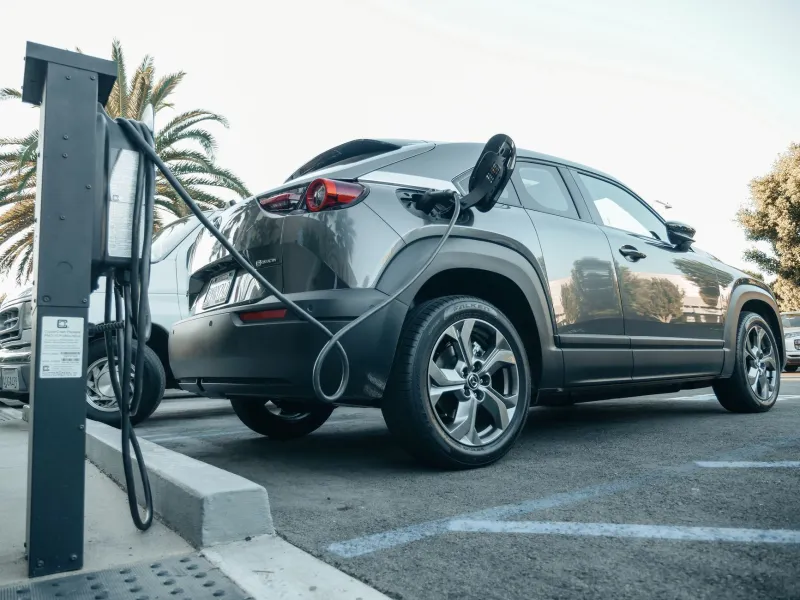
Photo: Stephen Craven, CC BY-SA 2.0, via Wikimedia Commons
A rooftop solar array is often presented as a route to near-free motoring. The arithmetic is more interesting. For a UK driver in 2026, the relevant question is not the headline size of the array but the pence per mile after self-consumption, export, battery losses and winter grid top-ups. Solar can reduce the marginal cost of each mile, but it rarely removes it, and the capital cost of the system still has to be paid by someone.
The four prices that matter
Four prices sit behind any solar-charging calculation. The standard import price is the rate paid when the home buys electricity from the grid. The off-peak price is the overnight rate on a time-of-use tariff. The export rate is what the home receives for surplus solar through the Smart Export Guarantee. The fourth is the levelised cost of the solar and battery hardware itself, spread over its expected life.
For an EV using 3.8 miles per kWh, each 10p per kWh works out at about 2.6p per mile. That simple relationship makes the comparison clearer. A standard grid rate of 26p per kWh is roughly 6.8p per mile. An off-peak rate of 8p per kWh is roughly 2.1p per mile. The solar question is whether the rooftop electrons can beat those figures after the losses and forgone export are included.
| Supply route | Indicative cost per kWh | Pence per mile at 3.8 miles per kWh |
|---|---|---|
| Standard grid | 26p | 6.8p |
| Off-peak grid | 8p | 2.1p |
| Direct solar, forgone export basis | 6p | 1.6p |
| Battery-stored solar, no battery capital | 6.8p | 1.8p |
| Battery-stored solar, with battery capital | 16.8p to 21.8p | 4.4p to 5.7p |
Direct solar without a battery
A solar system without a battery only helps the EV when the car is at home and the sun is generating. If the car is away during the day, the surplus is exported at the SEG rate and the EV charges later from the grid. For a household with a daytime-parked car, direct solar can be valuable. For a commuter who leaves before sunrise, the benefit is limited.
The effective cost of self-consumed solar is not zero. It is the export income that the household gives up. If the SEG rate is 6p per kWh and the import rate is 26p per kWh, using a solar kWh in the car saves 20p per kWh compared with buying from the grid, but the marginal cost is still 6p per kWh in forgone export. That is about 1.6p per mile. If the solar capital is allocated at 7p per kWh, the figure rises to about 1.8p per mile.
A realistic example makes the limit clear. A 4kWp array might generate around 3,600 kWh a year in central England. If 800 kWh is diverted to the car during daytime, that covers roughly 3,000 miles. The remaining 4,600 miles might need 1,200 kWh from the grid at 26p, costing £312. The forgone export on the solar portion is £48. The combined marginal cost is £360, or about 4.7p per mile over 7,600 miles. That is a genuine saving against 6.8p per mile, but it is not free motoring.
Battery storage in the middle
A battery changes the timing. Surplus solar that would have been exported can be stored and used in the evening or overnight. The penalty is round-trip efficiency. A lithium battery might return 88% of the energy put into it, so 1 kWh delivered to the car requires about 1.14 kWh of solar input. At a 6p export rate, the forgone export cost is about 6.8p per kWh delivered, or roughly 1.8p per mile before any battery capital is counted.
If the battery was bought mainly for the house, the incremental cost of using it for the EV can be low. If it was bought mainly to cut motoring costs, the arithmetic is less flattering. A levelised battery cost of 10p to 15p per kWh delivered turns the 6.8p solar kWh into 16.8p to 21.8p per kWh, or 4.4p to 5.7p per mile. That can still beat a standard grid rate, but it may struggle to beat a cheap overnight tariff.
Winter and the grid top-up
UK solar output is strongly seasonal. December and January generation can be a small fraction of the annual total, while EV consumption tends to rise in cold weather. Even a well-sized solar and battery system will buy grid electricity for much of the winter. The annual pence-per-mile figure is therefore a blend, not a summer best case.
A household that covers 40% of its EV miles from solar and battery at about 2p per mile and 60% from off-peak grid at 2.1p per mile would average around 2.1p per mile. If the grid top-up is at the standard 26p rate instead, the average rises to about 4.9p per mile. The difference is not the solar array. It is the tariff used for the remaining grid electricity.
Household patterns change the answer
A household with someone at home during the day can self-consume more solar and may need less battery capacity. A commuting household with the car away all day will rely more on overnight charging, where a time-of-use tariff often does the heavy lifting. Low-mileage drivers may find the capital payback weak because there are fewer miles over which to spread the hardware cost. High-mileage drivers may find that solar covers a smaller share of demand and grid top-ups dominate.
The honest comparison is therefore not solar versus grid in the abstract. It is direct solar versus export, battery-stored solar versus off-peak grid, and the capital cost of each option against the miles actually driven. A solar and battery system can be a sensible household investment, but the EV saving should be presented as a marginal benefit, not as a headline discount.
Separating savings from salesmanship
Ask for net pence per mile, not gross generation. Include forgone export, round-trip losses, battery capital, winter top-ups and the tariff that fills the gap. Compare the result with a simple off-peak tariff before committing to hardware. In many UK homes, the cheapest electron for the car will still come from the grid at 2am, while the rooftop system does useful work reducing the household's overall import. That is a real saving, but it is not the same as free motoring.